
How do we hear?
Sound
The process of hearing begins with sound. Sound is created when an object vibrates, causing the surrounding air, water, or any other medium to vibrate as well. These vibrations travel in waves and are detected by our ears as sound.
The intensity or loudness of sound is measured in decibels (dB), while the frequency or pitch is measured in hertz (Hz). Generally, humans can hear sounds ranging from around 20 Hz to 20,000 Hz (20 kHz). Younger children are often able to hear slightly higher frequencies, though this sensitivity gradually reduces with age.
Ear & Its Anatomy
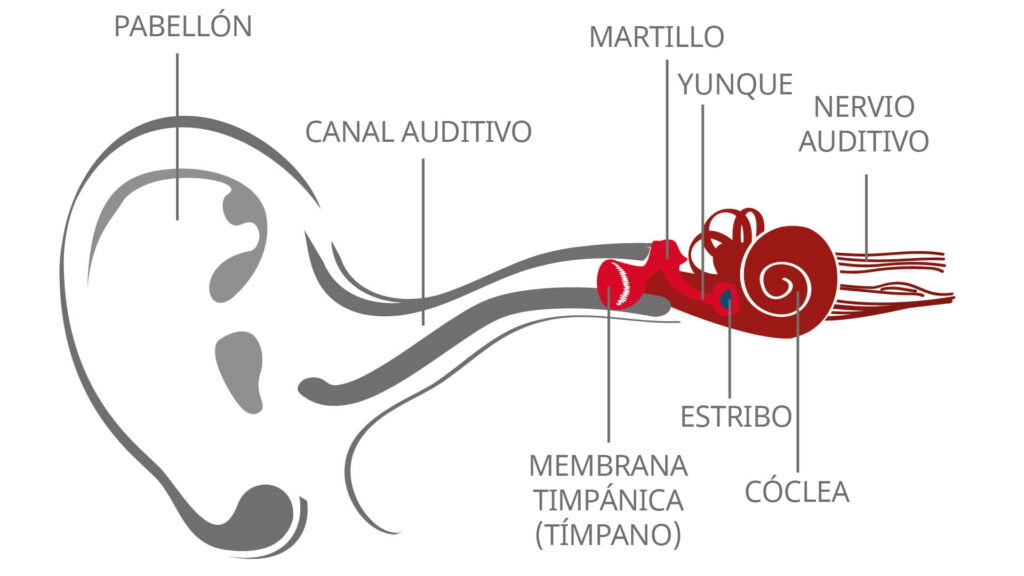
The ear is responsible not only for hearing but also for maintaining balance. It is divided into three main sections:
Outer Ear
The outer ear includes:
- Pinna (Auricle): The visible part of the ear that collects sound waves.
- Ear Canal: A narrow passage that carries sound towards the eardrum.
Middle Ear
The middle ear contains:
- Eardrum (Tympanic Membrane): A thin membrane that vibrates when sound waves strike it.
- Ossicles: Three tiny bones that help transmit sound vibrations:
- Malleus
- Incus
- Stapes
- Eustachian Tube: A small canal connecting the middle ear to the back of the nose, helping maintain equal air pressure for proper hearing.
Inner Ear
The inner ear is made up of:
- Cochlea: A spiral-shaped structure responsible for hearing.
- Vestibule: Helps control balance.
- Semicircular Canals: Assist in detecting movement and maintaining body balance.
How Hearing Works
Hearing is a detailed process that converts sound waves into electrical signals the brain can understand.
- Sound waves enter the outer ear and move through the ear canal until they reach the eardrum.
- The eardrum vibrates in response to these sound waves.
- These vibrations are passed to the three tiny bones in the middle ear — the malleus, incus, and stapes — which strengthen the sound signals.
- The amplified vibrations then travel into the cochlea in the inner ear, which is filled with fluid.
- Movement of the fluid creates waves along a structure called the basilar membrane.
- Tiny sensory cells known as hair cells sit on this membrane and move with the waves. Different hair cells respond to different sound pitches — high-pitched sounds stimulate one area, while lower-pitched sounds stimulate another.
- As the hair cells bend, they generate electrical impulses.
- These impulses are carried by the auditory nerve to the brain.
- Finally, the brain interprets these signals as the sounds we hear and recognise every day.